
Casino Dice Games in the UK: Formats and Licensing
 Available in GB
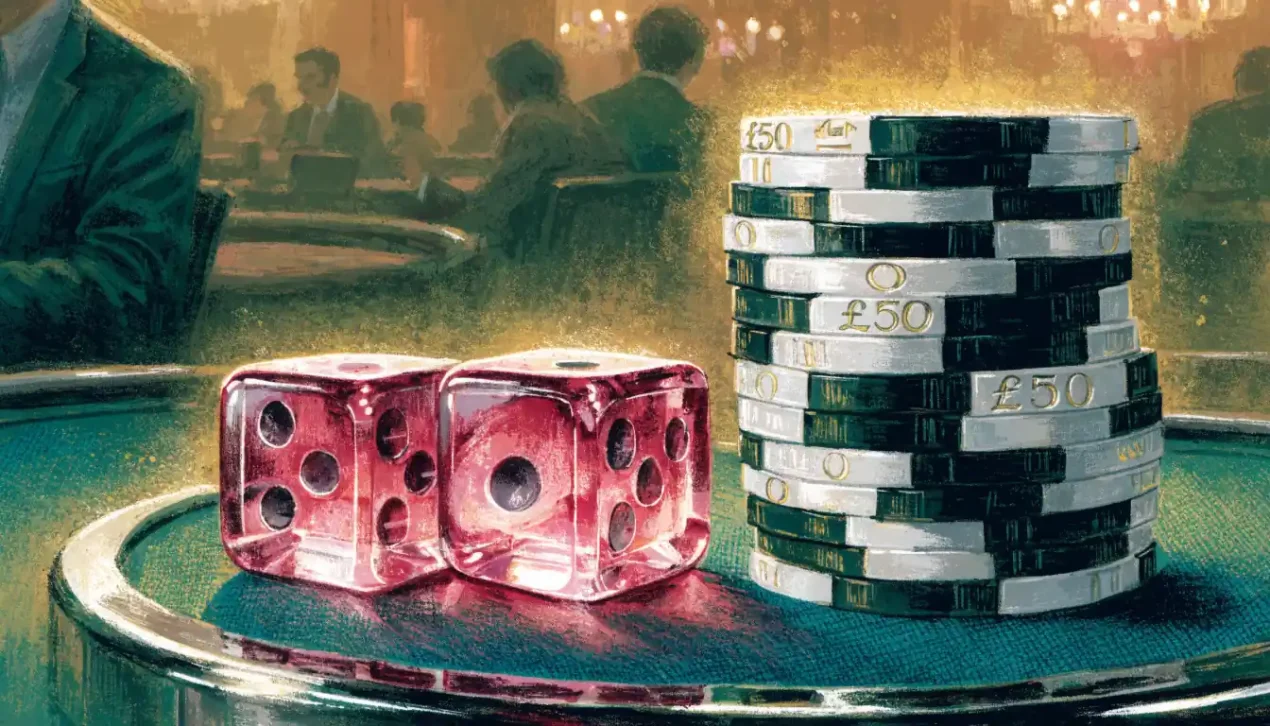
Casino dice games can rely on a roll or a generated number, while dice imagery in slots may not determine the wager.
What Counts as a Casino Dice Game?
A casino game involves staking cash or chips on an outcome. In a dice game, the result of a roll may be central to the wager, or dice may form part of a wider set of possible outcomes. The important distinction is that the player is risking something of value on what happens, rather than simply rolling dice for amusement.
A result can depend on one random event or on a combination of outcomes. For instance, a game may ask you to predict a particular result, or the wager may depend on how several results relate to one another. The rules determine what counts as a winning outcome and how a stake is settled. Without those rules, the presence of dice alone does not tell you how the game works.
The word “random” also covers more than a physical roll. In random-number games, a computer or other gaming equipment generates selected numbers. Those numbers determine the outcome presented to the player. A digital game can therefore use dice imagery without relying on physical dice being thrown; what matters is how its result is generated and what the rules say your wager depends on.
That distinction helps when you encounter the broad label “casino dice”. It may refer to a game where dice outcomes drive the wager, but the label on its own does not establish the rules, the way results are produced, or whether the experience resembles a traditional dice table. Read the game information to see what you are predicting and how the possible outcomes are defined.
A casino dice game in the UK in 2026 is best understood by its underlying wager, not its graphics. Dice on screen may be decoration; a dice-based wager makes the roll, or a number derived from it, relevant to the result. The same general principle applies to casino games more widely: you stake cash or chips on a possible outcome, which may be random or depend on a combination of outcomes. That is the basic idea, before considering how different games are presented.
Chicken Road Game in UK Casinos: What to Check
How Casino Game Formats Differ
Casino games are grouped in different ways, and the categories do not all describe the same thing. “Table game” and “gambling machine” point mainly to how play is arranged and who is involved. A random-number game is defined by how its numbers are generated. That distinction matters when you are trying to work out what a casino dice game actually involves: the presence of dice alone does not tell you whether you are looking at a table format, a machine or another kind of game.
Table games: a dealer-led format
Table games are generally played with a croupier or dealer conducting the game. Players compete against the casino, not against one another. The dealer’s role is part of the format, whether the game uses cards, dice or another means of producing its outcomes.
This is the clearest category for someone looking specifically for dice table games. In a dice-based table game, the dice are central to the play, but the table format also involves the casino and the person conducting the game. The players are not simply taking turns trying to beat each other. That is a different arrangement from a social game in which participants compete among themselves.
The phrase “casino games with dice” can therefore refer to more than one kind of experience. It may describe a dealer-led table game, but dice imagery or a dice-like result does not, on its own, establish that a game is a table game. Look at how the game is actually played: is there a dealer, and are you playing against the casino? Those details are more useful than the theme alone.
Gambling machines: individual play without a dealer
Gambling machines are generally played by one person at a time and do not need a casino employee to run each play. That makes them structurally different from table games, where a croupier or dealer is usually involved and players face the casino within a conducted game.
The distinction is about the playing arrangement, not simply whether a screen or equipment is present. A game does not become a table game because it shows dice, nor does a dice-based theme prove that a person is physically handling dice. If you are considering a machine format, focus on the way each play is presented and whether the game is operated individually rather than conducted by a dealer.
Table games
Generally played with a croupier or dealer conducting the game.
Gambling machines
Played by one person at a time without the need for a casino employee.
Random-number games
Identified by the use of computer or gaming equipment to generate results.
For people comparing casino games played with dice, this is a useful dividing line. A game can draw on familiar dice imagery while still belonging to a machine format; the deciding feature is the format of play, not the picture on screen. Conversely, a table game’s defining feature is not just the objects used, but the dealer-led structure and the relationship between the player and the casino.
Random-number games: how results are produced
Random-number games are identified by the source of their results: selected numbers are generated by a computer or other gaming equipment. This label says how the numbers are produced, rather than whether a dealer is present or whether players gather around a table.
That means “random-number game” is not necessarily an alternative to “table game” or “gambling machine”. One classification concerns the result-generation method; the others concern the playing arrangement. When a game involves dice, it is worth separating the visible or physical idea of a roll from the underlying format. A result presented as a number may be generated by equipment, while a dealer-led table game has a different structure.
For casino dice games in the UK, the practical comparison is therefore not just “dice or no dice”. Ask whether the game is conducted at a table, played individually on a machine, or described by the way its numbers are generated. These categories help you understand what role a dealer has, whether you are playing against the casino or handling an individual play, and what the game’s presentation does—and does not—tell you.
Playing Dice Games Online
Casino games can be offered through online casinos where the law permits them. That puts online dice play within a broader digital casino setting: you access a game through a website or app rather than sitting at a physical table. The format changes how you reach the game, but not the basic idea of staking money or chips on an outcome.
For a UK reader, legality is part of that context. Online gambling is lawful in the UK only through licensed and regulated sites. The details of how the UK and offshore markets differ are a separate question; the important point here is that a game appearing online does not, by itself, establish that it can lawfully be offered to you.
Mines Casino Game in the UK: Demo and Rules
“Online dice” can describe more than one kind of experience. Some games put dice outcomes at the centre of play; others may use dice as one element in a wider casino game. The label alone does not tell you how a particular game works. Before playing, look at the rules shown for that game and identify what outcome you are betting on. If the rules are unclear, the name or graphics are not a substitute for an explanation.
Online play also changes the setting in which you make decisions. You may move between games without the pauses associated with a physical venue, and the digital presentation can make a game feel straightforward to start. That ease of access is not evidence that the odds are favourable or that a particular outcome is due. Casino games generally give the casino a predictable advantage over the long term, even though players can make gains over shorter periods.
It is useful to separate the game itself from the way it is delivered. An online interface may present rules, choices and results on a screen, but those features do not make every dice game identical. The relevant questions remain: what are you staking, what outcomes count, and how does the game determine a result? Read the game’s own instructions rather than assuming that familiar dice imagery means familiar rules.
The same care applies when you encounter an online casino dice game on a phone or computer. A digital version may be easier to access than a venue-based game, but convenience does not remove the need to understand the wager. Take time to read the available information before committing money. If you cannot tell what a selection means or what must happen for a bet to win, do not rely on the visual layout to fill in the gaps.
Some people looking for dice play may instead encounter casino games in which dice are only part of the presentation. That distinction matters because a theme and a game mechanic are not the same thing. A dice-led game makes the result of a roll central to the wager; a game with dice imagery may use a different structure altogether. The description and rules should make clear which kind you are looking at.
JetX Casino Game in the UK: What to Check
Free play is another phrase associated with online dice games. It can refer to trying a game without staking cash, but whether a particular site offers that option depends on the site and game. A free version is not proof that the real-money version has the same terms or that a practice result predicts a later one. Treat any demonstration as a way to become familiar with presentation and rules, not as evidence of likely winnings.
Online access can make casino games available in places and at times when a physical casino is not part of the experience. It also puts more responsibility on you to pause, understand the rules and decide whether to continue. The format is digital; the financial risk is not.
UK and Offshore Dice Casinos: Two Different Markets
A specialist market review describes the online casino landscape in 2026 as having two distinct parts: the UKGC-regulated market and offshore platforms that operate outside it. That distinction matters whether you are looking for dice games, slots or another casino format. A dice table does not change the status of the site offering it.
In Great Britain, remote gambling operators serving local customers must hold the relevant UK Gambling Commission (UKGC) licence, wherever the operator is based. The Gambling Act 2005 governs gambling in England, Wales and Scotland, while Northern Ireland has a separate legal framework. Online gambling is legal in the UK through licensed and regulated sites. An operator’s location, branding or use of the word “UK” does not, by itself, establish that it is licensed to serve the British market.
Offshore casinos may accept players from the UK while operating outside the UKGC system. This means they are not part of the same regulated market as UK-licensed casinos. Acceptance of a British customer is not evidence of UKGC authorisation, and a site describing itself as a dice casino for UK players should not be assumed to have a UK licence on that basis.
DO
- Use only licensed and regulated sites
- Check the operator’s UKGC status via the public register
DON’T
- Assume a site is licensed just because it uses the word “UK”
- Trust a site’s own description of itself as “trusted”
The distinction is about the operator, not the appearance of a game. A site may present dice play as its main attraction, or offer it alongside other casino games, but the game’s theme does not determine whether the operator is regulated in Britain. Nor does a familiar-looking website make an offshore platform part of the UKGC market. The relevant question is which regulatory system the operator belongs to.
That difference is important because a UKGC licence places an operator within the rules for providing remote gambling to consumers in Great Britain. An offshore platform outside that system does not become a UK-licensed casino simply because people in the UK can reach it or create an account. “Available to UK players” and “licensed to serve the UK market” are not interchangeable descriptions.
The two categories can therefore appear side by side when you browse for online dice casinos, yet they do not have the same legal standing. Search results, promotional wording and a site’s own claims may not make the distinction clear. Treating the categories as equivalent would obscure the central point: UKGC regulation is a specific status, not a general label for every platform that accepts British customers.
It is also worth separating “offshore” from “UK-based”. The term refers here to a platform operating outside the UKGC regulatory space; it does not establish that the operator holds a British licence. Conversely, an operator’s physical location does not remove the requirement to hold a UKGC licence if it is selling remote gambling into the British market. The regulatory obligation follows the market being served, not simply the place where a company is situated.
For someone comparing dice casinos, this context is more useful than assuming that every site using UK-facing language belongs to the same market. A UKGC-regulated casino and an offshore casino may both accept online play, but that shared feature does not make their regulatory positions equivalent. The dice offering is only one part of the picture; the operator’s relationship to UK regulation is another, and the two should not be confused.
Crash Casino Games in the UK: Formats and Play
This is why broad labels such as “UK dice casino” can be misleading if they are read as proof of licensing. They may describe the audience a platform seeks, rather than its regulatory status. The same caution applies to claims that a casino is among the best or most popular: such wording does not tell you whether the operator is authorised to serve Great Britain.
The market distinction is not a technicality. UKGC-licensed operators are within the regulatory system that applies to remote gambling in Great Britain; offshore platforms accepting UK players remain outside that system. When you encounter both while considering where to play, keep those descriptions separate. A site’s willingness to accept customers from the UK does not make it part of the UKGC-regulated market.
Our top casino picks for the UK
- ZombillionBonus: Welcome Pack 250% up to £4000 + 200 FS · Payout speed: 1-3 business days
- JetsetspinsBonus: 200% Bonus + 100 Free Spins + Free Royal Wheel · Payout speed: 1-3 business days
- BritsinoBonus: Welcome Package – Get your £2,200 + 2,000 FS · Payout speed: 1-3 business days
- ChanzeBonus: Slots Welcome Bonus #1 200% up to €500 · Payout speed: 1-3 business days
- SlotoSportBonus: 500% up to £ 10 200+ 777 FS · Payout speed: 1-3 business days
- NightWinBonus: £900 + 400 free spins · Payout speed: 1-3 business days
- AmunbetBonus: Join now and get 450% up to 2,700 GBP + 450 FS · Payout speed: 1-3 business days
- WinBeastBonus: €5000 + 500 FS + €650 Freebet · Payout speed: 1-3 business days
Checking a Dice Casino Site’s Licensing Position
Before depositing money at a dice casino site, establish which company operates it and whether that operator is licensed to serve customers in Great Britain. The type of game on offer does not change the requirement: an operator taking bets from British residents must hold a licence under the Gambling (Licensing and Advertising) Act 2014. For real-money gambling in England, Scotland and Wales, the relevant regulator is the UK Gambling Commission (UKGC).
A site’s own description of itself as “trusted” is not proof of its licensing status. Nor does a dice game, slot or casino-style design tell you whether the operator is authorised. Treat licensing as a separate question from what the site offers.
Check the operator, not just the brand
Find the legal company name shown in the site’s terms or other operator information. Then check that name against the UKGC’s public register at gamblingcommission.gov.uk. A brand name and the company that runs it may differ, so searching only for the name displayed most prominently can make the result harder to interpret.
Compare the operator details on the site with the register entry. If you cannot identify the operating company, or the details do not match, do not assume that a licence has been verified. A logo or statement claiming UKGC oversight is not a substitute for checking the regulator’s record.
This applies whether you are considering a casino game with dice, dice-themed slots or another real-money product. The UKGC requirement concerns the operator serving customers, not whether a particular game looks familiar or is described as a dice casino.
Aviator Casino Game UK: Licensing, Demos and Bonuses
What the licence check tells you
A current UKGC licence is an important part of establishing whether a real-money casino is authorised to serve customers in Great Britain. It is not a guarantee that you will win, that every feature will suit you or that a site is “trusted” in every wider sense. Keep the claim narrow: the check is about the operator’s regulatory status.
If a site says it accepts British customers but you cannot confirm the operator’s UKGC licence, that does not satisfy the licensing requirement for real-money gambling in Great Britain. Do not treat a foreign licence, a site’s own assurance or the availability of dice games as an equivalent substitute.
When assessing UK casino sites with dice games, carry out the check before creating an account or paying in. If the operator’s identity or licence position is unclear, pause rather than relying on promotional wording. The same approach applies to dice slots and other casino products: first establish who is taking the bet and whether that operator holds the required UKGC licence.
Licensing is a practical starting point, not a shortcut to judging every aspect of a casino. But without a clear, verifiable position, you do not have a sound basis for treating a site as a UK-licensed option.
Dice-Roll Slot Games and Free Play
A search for a dice-roll slot game can point to two different kinds of play: a slot-style gambling machine with dice in its presentation, or a table game where rolling dice is central to the rules. They are not interchangeable. A slot is played as a machine game; a dice table involves a separate set of rules and play. The word “dice” in a title or description does not, by itself, tell you which format you are looking at.
Gambling machines are generally used by one player at a time and do not need a casino employee to run each play. That makes the experience different from a table game conducted by a dealer. If you want to learn how to play casino dice at a table, a slot-style game is not a substitute for an explanation of that table game’s rules.
A slot-style game is a machine game, whereas a dice table involves a specific set of rules and play.
What free play tells you
A demo or free-play option, when a casino provides one, lets you try a game without staking cash. It can help you see how the interface works and what choices the game presents. It does not establish that the same game is available for real-money play, or that every casino offers a free version. Availability can depend on the casino and the game.
Free play also should not be treated as a preview of a particular financial result. A practice session shows the game in that mode; it cannot tell you what will happen in a later session for money. Before starting, check whether you are in a demo mode or a real-money game, and whether the displayed balance is virtual or withdrawable.
If you find a game described as a dice slot, look at the actual format rather than relying on the wording. Is it presented as a machine game, or does it ask you to take part in a dice-based table game? That distinction matters if your aim is to practise table rules rather than explore a slot interface.
Terms such as “roll the dice” can describe a theme or an action without making the game a table game. A free-play version, if available, may be useful for getting familiar with the controls, but it does not answer how to play craps or another dice table game. Those require the rules of the specific table format.
Treat demo access as a way to understand what is on screen, not as proof about real-money availability or likely results. Check the game description and mode before you begin, so you know whether you are practising on a machine-style game or looking for a table game.
How Dice Imagery Fits into Slot Games
Dice on the screen do not necessarily mean you are playing a dice game. A slot can use dice as its visual theme while its play remains slot-style: the dice are part of the presentation, not necessarily objects whose roll determines the result. The distinction matters if you want a game in which dice outcomes are central rather than one that simply borrows their appearance.
Live Dream Catcher Casino UK: What to Check
In a casino game where you roll or throw dice, the result of the roll is central to how the game works. The rules explain what players are trying to predict or achieve from that result. A three-dice format, for instance, would make the dice outcome itself the focus. By contrast, a slot’s title, symbols or artwork may feature dice without making a roll the basis of play.
The label alone is not enough to tell you which kind of game you have found. Read the rules and look for an explanation of how a round is settled. If the instructions describe slot-style play and treat dice as symbols or decoration, it is a dice-themed slot. If they explain how the result of thrown dice determines what happens, the dice are doing more than providing a theme.
This also helps separate “roll the dice” language in a game’s presentation from a genuine dice mechanic. A dramatic animation may resemble a roll, but appearance is not a substitute for the rules. Check what the game says determines the outcome before assuming that dice imagery means you can influence or predict a physical-style roll.
Neither format removes the underlying gambling risk. Casino games generally give the operator a predictable advantage over the long term, while a player may still win in the short term. Dice graphics do not change that basic trade-off.
Assessing Dice Casinos Without a Best-Sites List
A “best” label tells you little unless you can see what it is based on. For a dice casino, begin with the operator’s licensing position: is it clear whether the site holds a UKGC licence, or whether it operates outside that system? Remote operators serving the British market must hold the relevant UKGC licence, whatever country they are based in. A site accepting UK players is not, by that fact alone, a UKGC-licensed casino.
Online casino tournaments in the UK: rules and prizes
A specialist review describes the UK market in 2026 as having two parallel spaces: UKGC-regulated operators and offshore platforms outside the UKGC system. Treat that as a description from that review, not a ranking or proof that any particular site is suitable. The distinction matters because the two categories do not have the same regulatory status. “Non GamStop” is sometimes used to describe offshore sites, but the phrase itself does not establish who operates a site or what licence it holds.
Once the status is clear, look for plain, consistent information about the operator and the games it offers. If a page calls a title a dice game, check its rules to understand what determines an outcome. Dice imagery alone does not tell you whether dice results drive the play or simply provide a theme for a slot. If rules are hard to locate or the description does not explain the game, a glowing review cannot fill that gap.
Be equally careful with claims about bonuses, payment methods or special features. A promotional headline is not the full terms, and a mention of Bitcoin does not verify that a casino accepts it. Check the relevant conditions on the operator’s own pages rather than assuming a review is current or complete. This is a way to test a claim, not a recommendation to play.
The same restraint applies to “best dice casino” lists. Rankings may reflect a reviewer’s chosen criteria, but a position on a list does not establish licensing status or explain whether a game matches what you want. Compare the evidence behind each claim: who operates the site, what its UKGC status is, and whether the game rules and offer terms are available and understandable. If those basics are absent, there is little sound basis for calling it the best.
Craps and Crypto: Two Different Search Intents
Craps is a table-game term, while “crypto” points to a payment question. They can appear together in a phrase such as a casino dice game played with cryptocurrency, but they describe separate things: the game a person wants to play and the way they hope to fund an account. Keeping those questions apart makes it easier to assess what a casino is actually offering.
Crazy Time Live Casino Game Show in the UK
In craps, players wager on outcomes associated with dice rolls. It is a table game: players compete against the casino, not against one another, and a croupier or dealer generally conducts play. That distinguishes craps from a slot or another machine-based game, even if the same dice imagery appears on screen. A request for a craps game is therefore about the rules and format of table play, not simply a casino that uses dice as a visual theme.
Crypto-related wording raises a different issue. It may signal interest in using a cryptocurrency at a casino, rather than a particular dice game. A platform’s payment options do not establish that it offers craps, and a craps listing does not establish that cryptocurrency is accepted. Treat each as a separate claim to verify: what game is available, and what payment methods the operator actually supports.
Phrases about “top” dice casinos add a third question: how to judge an operator. A ranking alone does not tell you whether the site has the relevant game, whether it accepts the payment method you want, or whether it is authorised to serve British customers. In Great Britain, remote gambling operators serving the market must hold the relevant UKGC licence. The fact that a site accepts UK players does not make it part of the UKGC-regulated market.
This distinction matters because the combination of terms can sound like one product category when it is really a bundle of separate expectations. First identify whether you mean craps as a table game, dice-themed machine play, or a way to pay. Then check each relevant claim on the operator’s own terms and licensing information. Avoid assuming that a general “dice casino” label confirms all three.
Bitcoin Payments at Dice Casinos
Bitcoin may appear as a payment option at some alternative gambling platforms, alongside other cryptocurrencies such as Ethereum and Litecoin. A specialist review reports that these platforms may also list conventional payment methods, including cards and e-wallets. That is not a guarantee that a particular site accepts Bitcoin, or that the method is available for both deposits and withdrawals. Payment options can differ by operator and may change, so check the cashier and the relevant terms before sending funds.
Online Bingo in the UK: How It Works with Casino Games
Using Bitcoin does not make a dice game different from a payment perspective: it is a way to move funds, not a type of game. Whether you are looking for a casino where dice outcomes are central or a Sic Bo table, confirm which payment methods the site supports and what conditions apply to them. Do not assume a Bitcoin balance can be used for every game or that a payment will be processed on a particular timetable.
The payment method also says nothing by itself about the operator’s regulatory status. A site accepting UK customers from outside the UKGC system is not equivalent to a UK-licensed casino. Treat Bitcoin acceptance as a feature to verify, not as evidence that a platform is suitable or authorised to serve you. For real-money gambling in Great Britain, the operator must hold the relevant UKGC licence.
If a site offers several ways to pay, compare the terms for each rather than focusing only on the currency logo. Check whether the stated method applies to withdrawals as well as deposits, and whether the operator sets conditions for using it. Read any dice casino bonus terms separately: a promotion does not change the payment method’s conditions, and bonus funds should not be treated as cash you can withdraw immediately.
Bitcoin can be relevant when assessing how a platform handles payments, but it does not settle the more important questions about licensing, terms or access to funds. Verify those details directly before depositing.
Bonus Terms to Check Before You Play
A bonus is not the same as cash you can withdraw. Check the terms for the wagering requirement: the amount of play you must complete before bonus funds or related winnings become withdrawable. Since 19 January 2026, a gambling incentive cannot require more than 10 times the bonus amount in wagering. So a £20 bonus at the maximum permitted requirement means £200 in total stakes.
Also check which products the offer covers. A single incentive cannot require you to gamble across different product types, such as casino games and sports betting. Read the full terms before accepting: they explain how the requirement applies and what conditions affect withdrawal.